
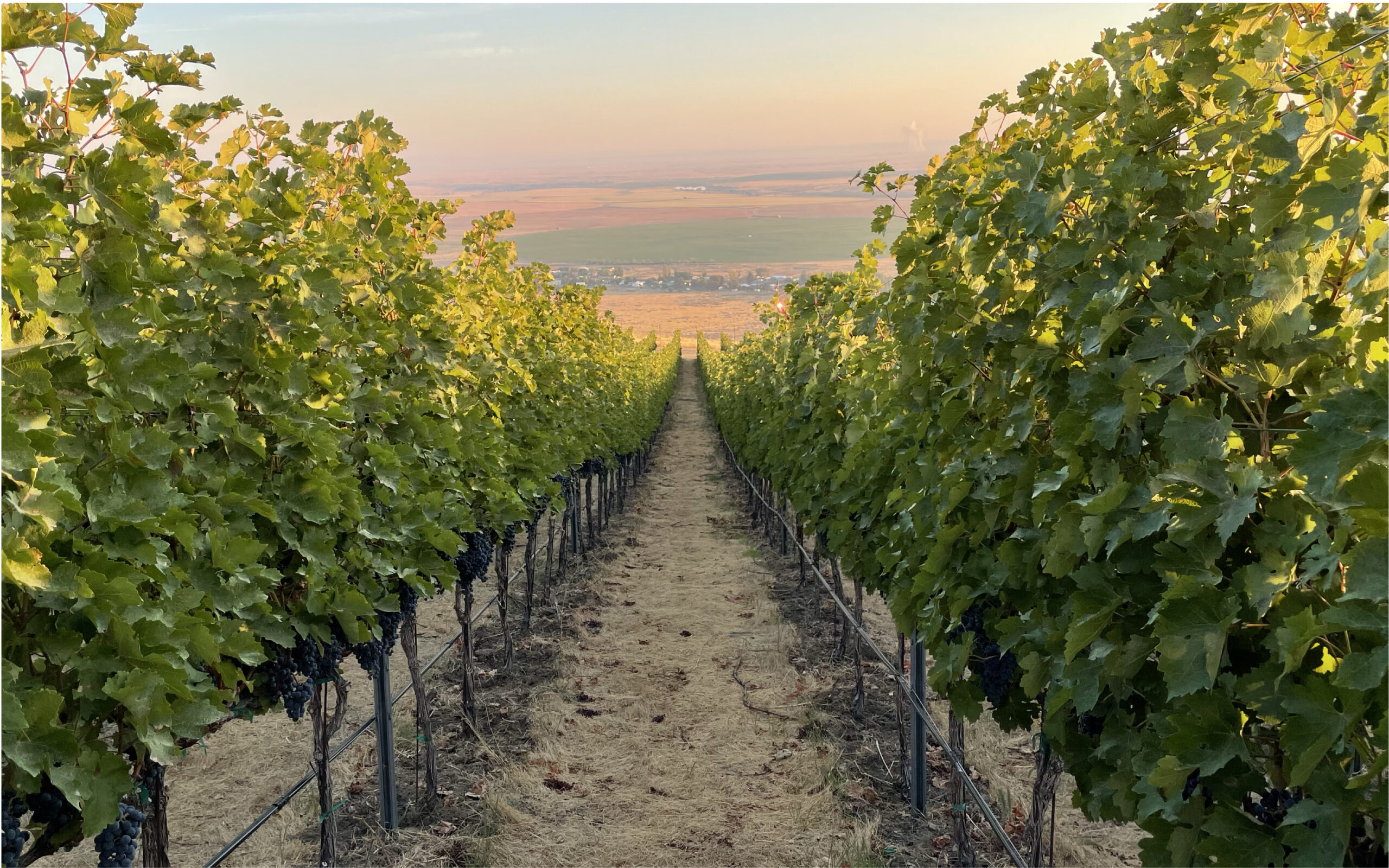
“What was once considered inhospitable has become a source of extraordinary character.”
— Ryan Johnson
ABOVE THE FLOODLINE
To understand WeatherEye, one must begin with what it is not.
Much of Red Mountain is shaped by the legacy of ancient floods—layers of sediment deposited over time, forming the foundation of the region’s viticulture. But WeatherEye rises above that history. Its upper ridges sit beyond the reach of those waters, revealing a more elemental landscape beneath.
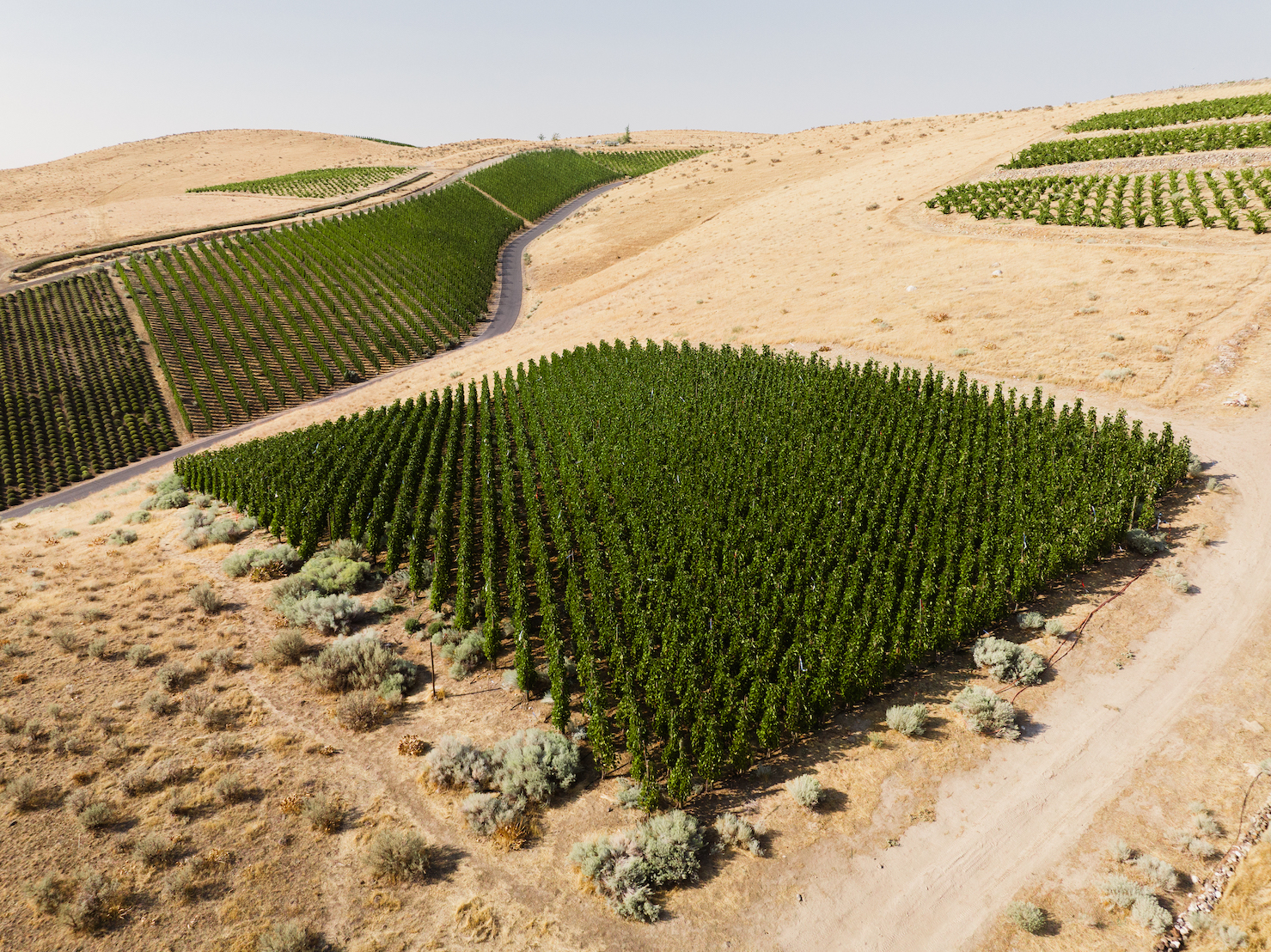
Here, the earth is fractured basalt and wind-blown sand. The slopes are steep, the soils thin, the exposure constant. It is a place that resists easy cultivation—one that was, for decades, considered inhospitable to vines.
And yet, it is precisely this resistance that defines it.
Roots push into rock. Vines adapt to wind and scarcity. The resulting fruit carries a concentration and structure that is inseparable from the land itself—intensity balanced by lift, power shaped by tension.
“The harsh conditions—wind, rock, and slope—have been transformed into assets that define the wines.” – Cameron Myhrvold
Watch a flyover of WeatherEye Vineyards!
THE FIVE FORCES, REIMAGINED
Red Mountain is defined by a set of natural conditions that have long made it one of Washington’s most distinctive winegrowing regions. At WeatherEye, those forces are not only present—they are amplified.
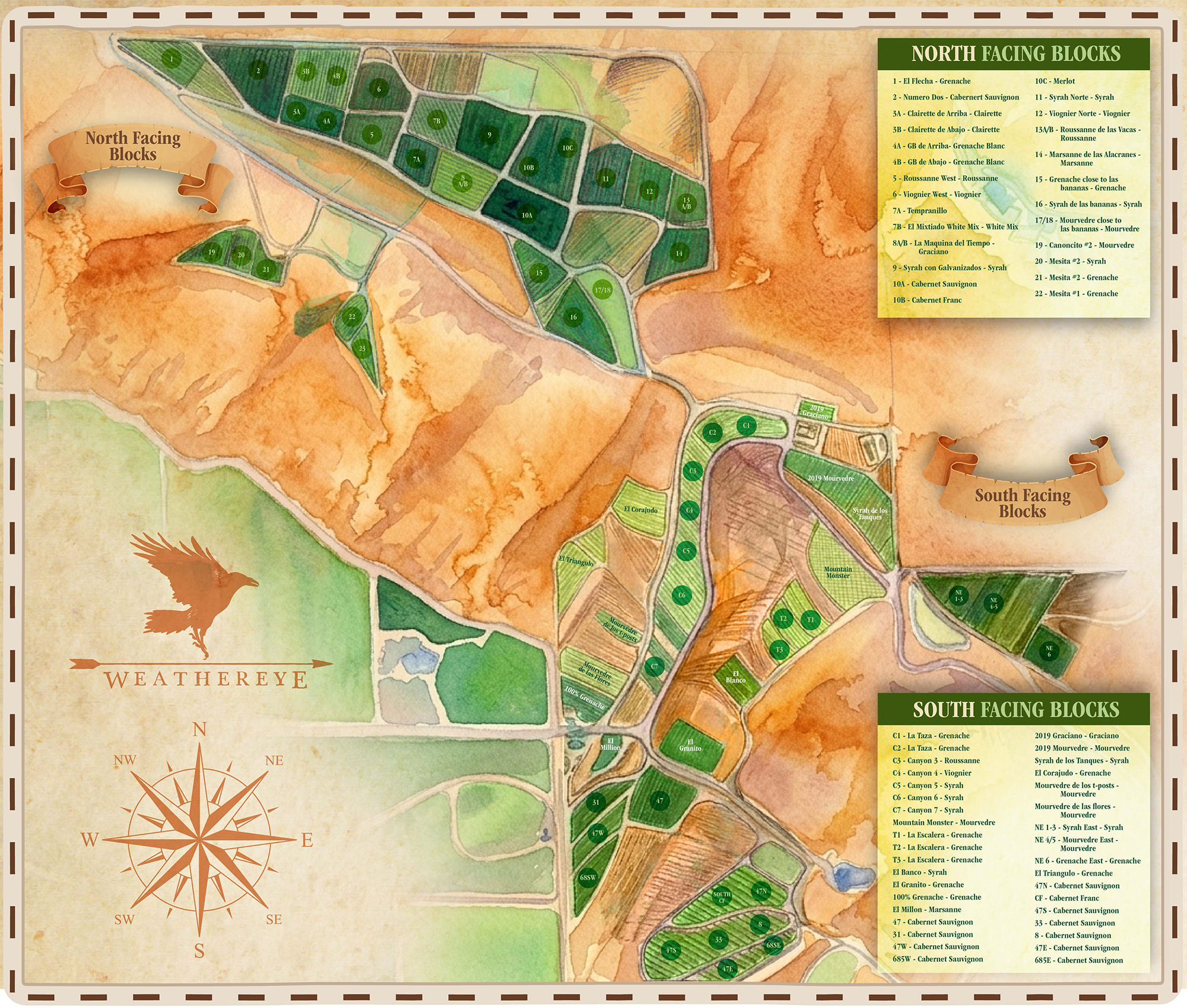
The soils, a mosaic of fractured basalt and sandy loess, vary dramatically across short distances. Rather than smoothing over that variation, the vineyard is divided into dozens of micro-blocks, each matched carefully to its geological character.
The slopes, steep and deliberate, open fully to the southwest, drawing in long hours of sunlight that build depth and structure within the fruit. At the same time, persistent winds move across the ridgeline, reducing yields and concentrating flavor while preserving freshness.
Temperature shifts define the rhythm of the growing season. Warm days bring ripeness and richness, while cool nights—shaped by elevation and the nearby Yakima River—lock in acidity and precision. Rainfall is scarce, and the soils drain freely, encouraging vines to find their own balance with minimal intervention.
Together, these elements create not just a vineyard, but an environment where every factor contributes to expression.
FARMING AT THE EDGE
Farming at WeatherEye is an exercise in attention to detail. The vineyard is not treated as a single entity, but as a collection of distinct sites—each with its own needs, its own timing, its own voice.
Across the property, vine density varies dramatically, from widely spaced plantings to tightly packed rows that rival the most intensive vineyards of Europe. Many vines are head-trained using traditional Rhône methods, allowing them to adapt naturally to wind and sun while maintaining balance.
The work is deliberate and often unconventional. In some areas, native vegetation is preserved among the vines, encouraging biodiversity and strengthening the ecosystem. In others, the physical challenges of the site—rock, slope, exposure—require creative solutions that blur the line between agriculture and craft.
This is not efficiency-driven farming. It is precision-driven farming.
A LANDSCAPE OF EXTREMES
Elevation defines everything at WeatherEye. Rising from roughly 950 to over 1,400 feet, the vineyard stretches into terrain long thought unsuitable for grape growing. At its highest points, wind becomes a constant force, and soil gives way almost entirely to stone.
And yet, vines persist.
They are shaped by the elements—by wind that thickens skins and concentrates flavor, by temperature swings that preserve structure, by soils that demand resilience. These conditions slow the pace of growth, extending the season and deepening complexity.
The vineyard does not seek to soften these extremes. It embraces them, allowing challenge to become character.
“The vineyard is a case study in terroir—an ongoing exploration of soils, aspects, elevation changes, vine training, and sun and wind exposure.” – Ryan Johnson
AN EVOLVING EXPRESSION OF PLACE
WeatherEye is not static. It is a living system, continuously observed, adjusted, and refined. Each vintage reveals something new—not only about the vines, but about the land itself.
No two blocks are identical. No single perspective defines the whole. Instead, the vineyard unfolds as a mosaic of expressions, each contributing to a broader understanding of place.
In the end, WeatherEye is less about conquering a landscape than learning from it. Through that process, it has become one of the most compelling vineyard sites in Washington State—an elevated, elemental, and deeply articulate expression of Red Mountain.